Sunday, May 11, 2014

Get Your Kicks on Route 66


VOCABULARY
wave: up and down 
twisting up: force tightly 
interstate: cross-state
wealthy : having a great deal of money asset
mineral: natural source
occurance: incident, event
stalagmite: stone mine
stalacities: stone mine
From VOA Learning English, welcome to This Is America. I’m Steve Ember. Today, Barbara Klein and I take you on a ride through the colorful history of Route 66, a road that has been called "The Main Street of America.”  Come along with us!              

 [Rosemary Clooney  sings “Route 66”]

If you ever plan to motor west
Travel my way, take the highway that’s the best
Get your kicks on Route 66

The idea for Route 66 started in Oklahoma.  Citizens there wanted to link their state with states to the east and west.  By the 1920s, federal officials wanted to connect state roads to provide a shorter, faster way across the country.  So a plan was developed to connect existing state roads into one long national highway.

United States Highway 66 was established on November 11th, 1926.  It was one the first federal highways.  It crossed eight states.  It was 3,800 kilometers long. 
                                                      
Route 66 became the most famous road in America.  It passed through the center of many cities and towns.  It crossed deserts, mountains, valleys and rivers.

In the 1930s, people suffered through the Great Depression. In Oklahoma, many poor families lost their farms because of dust storms. So they traveled west to California on Route 66 in search of a better life.

In 1939, John Steinbeck wrote about these families in "The Grapes of Wrath."
Author John Steinbeck, takes a rest from intense work on a new novel in an undated photo. (AP Photo)Author John Steinbeck, takes a rest from intense work on a new novel in an undated photo. (AP Photo)
In his book, Steinbeck wrote: "66 -- the long concrete path across the country, waving gently up and down on the map ... over the red lands and the gray lands, twisting up into the mountains, crossing the Divide and down into the bright and terrible desert, and across the desert to the mountains again, and into the rich California valleys.”

Steinbeck wrote: "66 is the path of a people in flight, refugees from dust and shrinking land … 66 is the mother road, the road of flight."

In 1946, the songwriter Bobby Troup and his wife drove across the country to Los Angeles.  He wrote a song about traveling on Route 66.  The song told people they could have fun, could get their kicks, on Route 66.
                                        
In Los Angeles, Bobby Troup took the song to Nat King Cole, who recorded it with his trio.  It became a huge hit. 

If you ever plan to motor west
Travel my way, take the highway that’s the best
Get your kicks on Route 66
It winds from Chicago to L.A.
More than two thousand miles all the way
Get your kicks on Route 66
Now you go through Saint Louis, Joplin Missouri
And Oklahoma City looks mighty pretty…

In the 1950s, holiday travel brought more and more families out West to explore. Route 66 represented the spirit of movement and excitement.

[Martin Milner (Tod) from TV Series “Route 66”]

Goodbye, Pittsburgh, Hello…Hello, World                          

In the 1960s, Americans watched a popular television series called "Route 66."  It was the story of two young men, Buzz and Tod, driving across the country, and coming into the lives of those they meet along the way. 
Martin Milner, George Maharis, and guest star Ethel Waters from the "Route 66" episode "Good Night Sweet Blues"Martin Milner, George Maharis, and guest star Ethel Waters from the "Route 66" episode "Good Night Sweet Blues"


[Guest star, jazz singer Ethel Waters and George Maharis as Buzz from the episode “Goodnight Sweet Blues”]

That music…

Oh, yeah, I’ll turn it off...

No, no sugar, it’s pretty...I thought I was the only one hearing it, but if you hear it too, that means I’ll be around a while longer. [She laughs, then gasps] I think I’m gonna faint. Don’t be frightened, son, don’t be frightened, it’s all right. If the lord’s callin’ me home, it’s as good a way to go as any, with music.
                                                             
The show was filmed in cities and towns across America.  Yet only a few shows were filmed on the real Route 66. That didn’t seem to matter, because the stories captured the spirit of adventure, of travel on the highways of America.
                                                      
In real life, people were getting fewer and fewer kicks on Route 66.  By 1962, parts of the road were closed because they were in poor condition. 

The federal government was building bigger highways, on which cars and trucks could travel at higher speeds…and where they didn’t have to stop at traffic lights, or slow down for small towns.  People started driving on these new interstate highways instead of the old Route 66. 

Finally, in 1985, Route 66 was officially removed from the national highway system.

People have formed groups to save parts of the old 66 and many of the interesting places to eat, stay and see along the way.

Award-winning writer Michael Wallis is an expert on the historic highway. He is the author of "Route 66: The Mother Road."

Michael Wallis was born in Saint Louis, Missouri, right off the highway. He has lived in seven of the eight states along its path. His website, michaelwallis.com, has information and stories about the history of the Mother Road.

 “ROUTE 66”/Chuck Berry 

Now it goes through Saint Loius, Joplin Missouri
And Oklahoma City looks ooh so pretty
You’ll see Amarillo, Gallup, New Mexico
Flagstaff, Arizona…


Now it is our turn to take a trip on Route 66. We will have to search for it at times. Many parts of the road have new names or numbers. Some parts of it are included in other interstate highways.
  
The Willis Tower, formerly known as the Sears Tower, in Chicago Illinois is 442 meters tall.The Willis Tower, formerly known as the Sears Tower, in Chicago Illinois is 442 meters tall.
Our trip begins in the Midwest, in Chicago, Illinois. Almost three million people live there. Chicago is America’s third largest city.

You can learn more about Chicago by listening to our This Is America program about that city. You’ll find it on our web site.

From Chicago, the road goes southwest through many small towns in Illinois. One of them is Springfield, the home of America’s 16th president, Abraham Lincoln.

Now we cross into Missouri. We drive through Saint Louis, the city known as "the Gateway to the West." More than 300,000 people live there.

There are many natural wonders to see in Missouri. One of the most famous along Route 66 is Meramec Caverns in Stanton.

Inside the cave, visitors see beautifully colored stalagmites and stalactites. These are mineral formations. Stalagmites rise from the floor; stalactites hang from the ceiling.

Long ago, local Indian tribes used the Meramec Caverns for shelter. A French miner named Jacques Renault discovered saltpeter in the caverns in the 1700s. The material was used to produce gunpowder.

Later, the outlaw Jesse James is said to have used the caverns as a hiding place.
  
A wall cloud forms near Purcell, Oklahoma. The state often has tornadoes and other extreme weather.A wall cloud forms near Purcell, Oklahoma. The state often has tornadoes and other extreme weather.
From Missouri, our drive takes us for a very short time through the state of Kansas. Then we enter Oklahoma. Oklahoma may well be the heart and soul of Route 66. That is because there are more kilometers of the road in Oklahoma than in any other state.

In Claremore, Oklahoma, a statue honors a famous American, Will Rogers. Will Rogers was born in Claremore. He became a popular actor, radio broadcaster and newspaper writer in the 1920s and 30s.

We pass through many historic towns in Oklahoma. In Oklahoma City, we can visit the National Cowboy Hall of Fame and Western Heritage Center.

And in Clinton, we can stop at the Route 66 Museum. This official museum tells the complete history of the road and its importance to America.

Now we drive through the northern part of Texas. The area is called the Texas Panhandle. We stop near the city of Amarillo to look at some unusual art that celebrates Route 66. Welcome to Cadillac Ranch.

A Cadillac is a large, costly automobile. Cadillac Ranch has ten of them half buried in the ground. A wealthy farmer and art collector named Stanley Marsh created Cadillac Ranch to honor America’s roads.

Continuing west, we travel through the states of New Mexico and Arizona. We pass through some of the most beautiful country in the Southwest.

Petrified Forest National Park is one of the natural wonders of Arizona. Trees that are millions of years old have turned to stone in unusual shapes.

North of Route 66 is a desert known for its red and yellow sand and rocks. Its name is the Painted Desert.

 “ROUTE 66”/John Mayer 

We continue on our trip, driving on a winding road up and down the Black Mountains. We arrive at Oatman, Arizona. Long ago, Oatman was a rich gold-mining town. Everyone left the town when the mining ended. Today Oatman still looks like it did in the past.

Now we enter California. We pass through the Mojave Desert, some mountains and several interesting towns. The old highway gets lost among the modern road systems of Los Angeles.

Finally, we arrive at the Pacific Ocean in the city of Santa Monica.  There, our trip ends.  We watch the tide come in, and thank Route 66 for an interesting ride.                     
Our program was written by Jerilyn Watson and Shelley Gollust. 

With Barbara Klein,  I'm Steve Ember, inviting you to join us next time for another “This Is America” from VOA Learning English.

If you’d like to learn about other interesting places to visit in the United States, check the “This Is America” section on our VOA Learning English web site.
  
​ 

Looking for Vaccines Outside the Cold Chain

Looking for Vaccines Outside the Cold Chain


VOCABULARY
urging: force immensely to do something
cold chain: a cool and breeze system that keep temperature staple
end user: consumer
shortage: lack of stock, deficient
scare: shortage
fragile: too delicate
immune: resitant to a particular infection
------------------------------------
Hello, and welcome back.  I'm Jim Tedder in Washington.  Today we will help you improve your American English while giving you some new information about medicines.  This is the kind of thing that may save lives.

Then we turn to the world of American politics.  The United States has never had a woman President.  Could Hillary Clinton become the first one?  Stay with us and hear what the experts are saying.

As It Is is coming your way from Washington.


Most vaccines must be kept in a cool place all during the time when they are being transported and used.  That is a big problem in some developing countries where electricity and transportation are not always available.
                                    
Some non-governmental organizations are urging drug makers to investigate whether their vaccines can be shipped safely at room temperature.  One such group, Doctors Without Borders, believes that room temperature vaccines – vaccines that are outside what has been called the “cold chain” – will reach more people.  Anna Matteo has the story.

The “cold chain” requires that vaccines be kept in a cool environment, with no changes in temperature, until they reach the end user.  This "cold chain" is supposed to keep the medicine effective and stop it from going bad.

But the group Doctors Without Borders says the cold chain leads to vaccine shortages.  And it warns these shortages result in 20 percent of children below the age of one going without their vaccinations each year.

Kate Elder serves as a vaccine advisor to the group.  She says that because most vaccines are produced by Western drug makers, keeping them cold is not a problem in developed countries.  The problems start, she adds, when you try to provide these medicines in other countries.

“But when you get into context like Chad and Democratic Republic of the Congo and South Sudan, where electricity is scarce and where roads are very poor and transportation very difficult, it becomes a huge challenge to keep these relatively fragile commodities cold all the way through to areas where kids need them.”

So Doctors Without Borders is urging drug makers to test vaccines to see whether they can be kept at temperatures up to 40 degrees Celsius.

One vaccine that stays effective at higher temperatures is MenAfriVac.  It is used to prevent meningitis-A in children in African countries where meningitis is a big problem.  MenAfriVac is effective without refrigeration equipment for up to four days.

Another such vaccine is the tetanus toxoid vaccine from the Serum Institute of India.  A research group from France recently tested the tetanus toxoid vaccine in Chad.  The researchers found that it too worked outside the “cold chain.”  It stayed effective for up to one month at temperatures up to 40 degrees.  And it gave the same level of protection as the vaccine kept in a strict “cold chain.”
                            
Kate Elder says the results suggest that more immunization drugs probably do not need refrigeration all the time to be safe and effective.

“The number of these vaccines might actually be more thermo-stable than what they are labeled for at refrigeration requirements of two to eight degrees Celsius.  So, what we are doing is pushing the manufacturers - the companies that make these products - to make sure that we can use them to that utmost thermo-stable potential.”

Doctors Without Borders is urging drug makers to lead this effort – an effort that shows some vaccines may be safely transported and used when stored outside the “cold chain.”  This effort will lead to vaccines that can be approved for use in parts of the world that do not have dependable refrigeration – places that usually have the greatest need.

I’m Anna Matteo.

   
Will it be "Madam President"?
 
The next presidential election in the United States is still more than two years away.  But any discussion of possible candidates among Democratic Party activists begins with former Secretary of State Hillary Clinton.  She has a huge lead in studies of likely voters.  Just the possibility of her candidacy is having a major effect on the race for the presidency.

Hillary Clinton may not yet be a candidate for president.  But she has been busy giving speeches, singing with school children and preparing to become a grandmother.  Her daughter Chelsea recently announced that she and her husband expect their first child later this year.

Yet Hillary Clinton has said little about her political future.  But in her speeches, she is a strong supporter of women’s rights.

“I believe that advancing the rights, opportunities and full participation of women and girls here at home and around the world is the great unfinished business of the 21st Century.”
 
John Sides is a member of the Department of Political Science at GeorgeWashington University in Washington, D.C.  He says Hillary Clinton would be a major political force if she seeks the Democratic presidential nomination.
 
“She is probably as best-positioned to be the Democratic nominee in a yearwith no incumbent president as any recent Democratic nominee has been. So really the race is hers if she wants it.”
 
But, he says the question is does she want to seek the nomination after herloss to Barack Obama in 2008?
 
“She is a known quantity to most voters.  I do not think she has to worry aboutimage management yet and ultimately it is just a question of whether shethinks she has the necessary stamina and the desire to actually pull this off.”
 
Stephen Hess studies politics for the Brookings Institution, a private, public-policy group in Washington.  He says Hillary Clinton will be a political target ifshe decides to enter the race.
 
“If you are way out there everybody is shooting at you, gunning at your back, not only other possible candidates, but certainly the media.  So she is in  avery exposed position.  On the other hand, a very good position is that she israising a lot of money and that is very important in presidential politics.” 
Hillary Clinton speaks in Las Vegas.Hillary Clinton speaks in Las Vegas.

If Ms. Clinton is a candidate, she will face morequestions about her actions during and after the 2012attack on the American diplomatic offices in Benghazi,Libya.  John Boehner is the speaker of the House ofRepresentatives.
 
“And when it comes to Benghazi, we have got fourAmericans who are dead and their families deserve thetruth about what happened and the administrationrefuses to tell them the truth.”
 
But that incident seems to have done little to hurt her popularity, says KarlynBowman of the American Enterprise Institute.
 
“I have been reviewing all the polls ever, all the poll questions ever asked onHillary Clinton, and there are probably several thousands of them, at least.  And I just finished review, and it is a remarkably favorable picture when youlook at the whole picture over time since 1992.”
 
The former Secretary of State wrote about her years as America’s topdiplomat.  That book, called Hard Choices, will be published in June.
 
And here is a brief history lesson for you.  On this date in 1915, the man whobecame America’s most famous baseball player, Babe Ruth, hit his first homerun.  At the time he was playing for the Boston Red Sox.
 
On this date in 1937, the dirigible …or big passenger carrying balloon …theHindenburg, exploded at Lakehurst, New Jersey.  It was the biggest news of the day. 
 
And American actor Orson Wells was born on this day in 1915.  His film“Citizen Kane” is considered one of the best ever made.
 
We have to move aside for more Learning English programs, and then worldnews at the beginning of the hour.  I’m Jim Tedder in Washington, and you arelistening to VOA.

Monday, April 28, 2014

[BBC]Mystery of ocean 'duck' sound solved

Summary

25 April 2014
A sound like a duck heard in the Southern Ocean has confused scientists for 50 years. But the mystery has now been solved, according to research published in the Royal Society journal Biology Letters.
Reporter:
Rebecca Morelle
Antarctica
The strange noise was recorded in the sea around the Antarctic

Listen

Click to hear the report

Report

This is the noise that's puzzled scientists for more than 50 years. The mysterious sound can be heard in the winter in the seas around Antarctica and Australia.

It's nicknamed "the bio-duck" by those who think it sounds like a duck quacking.

Now researchers say acoustic recorders attached to two Antarctic minke whales have revealed that the bizarre noise is the animal's underwater chatter.

Scientists say solving this long-standing mystery will help them to learn more about these little-studied mammals and help them to establish where the whales can be found.

[BBC]Titanic letter sells for £119,000

Titanic letter sells for £119,000

Summary

28 April 2014
The last letter to be written on the ill-fated Titanic has sold for £119,000 at auction.
It was written by survivors Esther Hart and her young daughter hours before the ship hit an iceberg and sank in 1912.
Reporter:
Duncan Kennedy
Antarctica
Titanic memorabilia is big business at auction houses


Report

Esther Hart sat down with her seven-year-old daughter Eva to write the letter just eight hours or so before the Titanic hit the iceberg. It was for her mother in London. And in it Mrs Hart wrote that they were enjoying what she called "the wonderful journey".

She said they were likely to arrive in New York early because of the speed at which the ship was travelling.

The letter ended up in the coat pocket of her husband Benjamin and only survived because he gave her the coat to keep warm. He died along with more than 1,500 others.

Titanic memorabilia continues to be big business. A menu on the day of the disaster was recently sold for £76,000 whilst a violin, played as the ship sank, went for £900,000
.
or so
approximately; more or less
hit
(here) crashed into
likely
probably
survived
stayed alive after nearly dying because of an accident or illness
memorabilia
objects which people collect because they are related to a particular place, person or event
big business
financial activites which generate a lot of money

[VOA]'Windy City' Offers Loop, Lakefront, Lots of Things to Enjoy

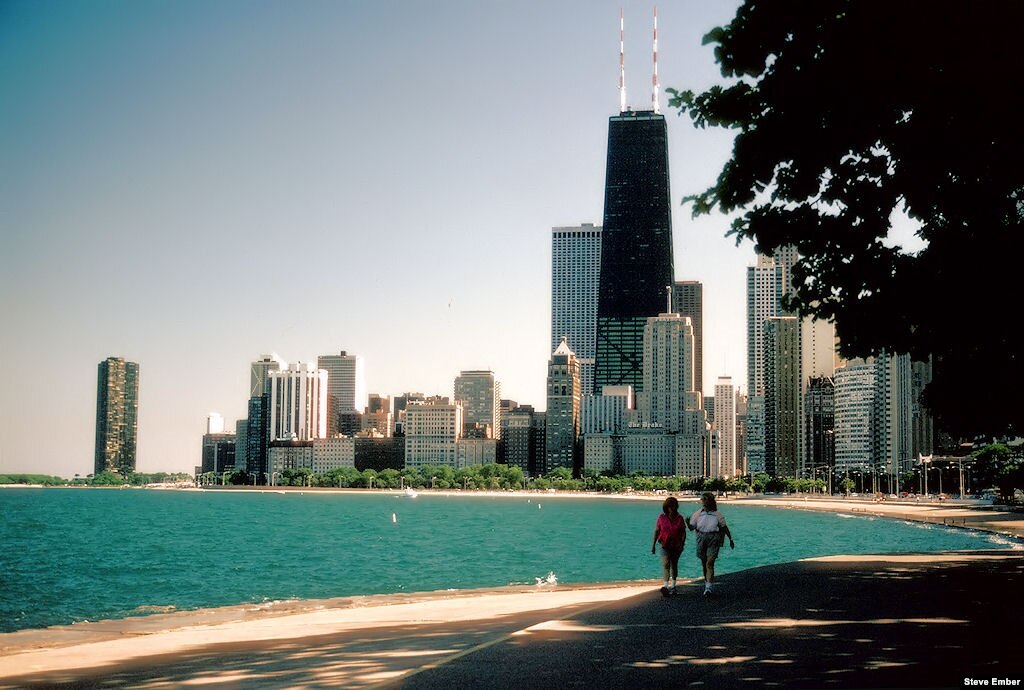
Oak Street Beach along Lake Michigan on Chicago's Near North Side
Play or download an MP3 of this story


From VOA Learning English, welcome to This Is America.  I’m Steve Ember.  Today, we visit Chicago, Illinois.  It is America’s third largest city.  It has The Loop…the Lakefront…and lots of exciting things to enjoy.  Come along with us, as we visit the “Windy City.”

Chicago has many nicknames besides “The Windy City.”  A number of them came from the lines of American poet Carl Sandburg, including “Hog Butcher for the World,” “Player with Railroads,” and “City of the Big Shoulders.”

But many simply – and proudly - call it:
My kind of Town, Chicago is
My kind of town, Chicago is
My kind of people, too
People who smile at you

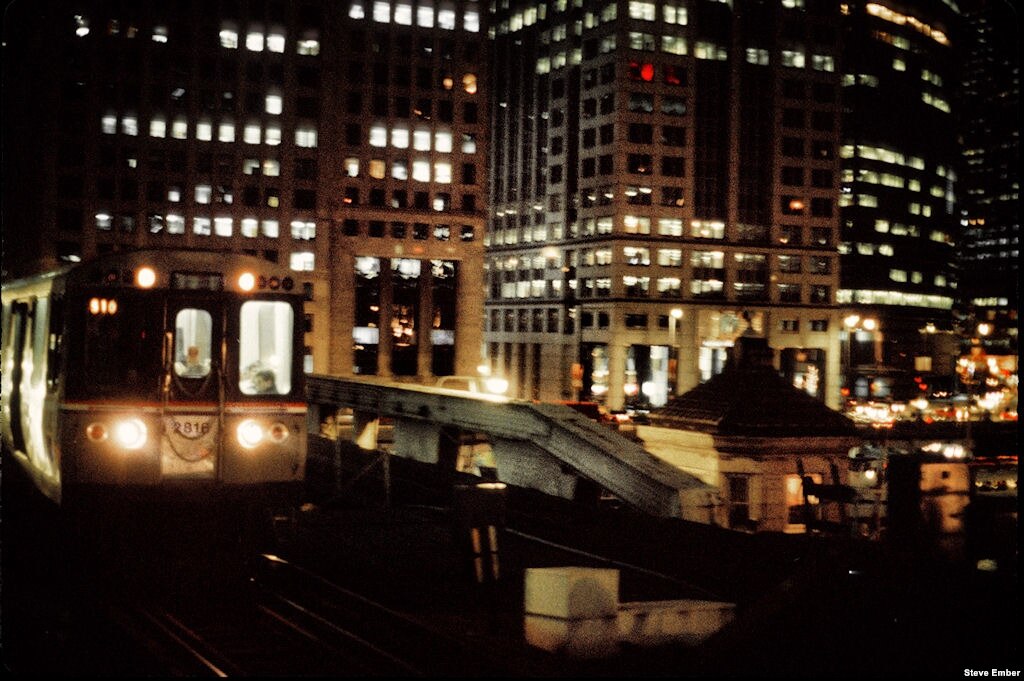
We’re aboard/on a Chicago Transit Authority elevated train, heading for Chicago’s downtown center known as “The Loop.”

[Train Announcement]
“This is Adams and Wabash. Transfer to Orange and Green Line trains at Adams and Wabash.  This is a Brown Line train to Kimble.”

The system, also known simply by the letter "L," carries trains from Chicago’s northern, western, and southern areas, and then makes a complete circle – or loop – of the downtown district, on a large overhead structure, with many station stops, running high above the city streets.

“This is Madison and Wabash.”

There are also two subway lines running under the Loop, which serve additional routes of the city’s extensive rapid transit rail network.
  
Chicago "L" train crosses Chicago River on the Wells Street Bridge. (Photo by Steve Ember)Chicago "L" train crosses Chicago River on the Wells Street Bridge. (Photo by Steve Ember)

The “L’s” elevated railway loop is bordered by Wabash Avenue on the east, Lake Street and the Chicago River on the north, Wells Street on the west, and Adams Street on the south.

Each station along the “L” provides easy connections to shopping, hotels, restaurants and food stands, entertainment, music and cultural centers, and city and state government offices. The Loop is also the location of the city’s financial district, centered around La Salle Street. The financial district is home to the Chicago Board of Trade, the Chicago Stock Exchange and many banks.

In the Loop, you’ll also find the Willis Tower. It’s the tallest building in Chicago, with its Skydeck observation level providing visitors with exciting views of the city.

‘Chicago Picasso’ - A Nice Gift, But What Does It Represent? 
The Picasso Sculpture in Chicago's Daley PlazaThe Picasso Sculpture in Chicago's Daley Plaza


The Chicago Picasso sculpture is a popular destination in the Loop’s Daley Plaza. It was a gift from the Spanish artist Pablo Picasso to the people of Chicago. It’s an eye-catcher and children love to climb on it, but no one seems to know what the sculpture represents.

Chicago newspaper columnist Mike Royko, covered the unveiling of the sculpture in 1967. He wrote: “Interesting design, I’m sure. But the fact is, it has a long stupid face and looks like some giant insect that is about to eat a smaller, weaker insect.”

Well, as we say, beauty is in the eye of the beholder.

The Loop district actually extends east to the wide boulevard of Michigan Avenue, with its large stretches of green parkland along the shore of Lake Michigan. It also extends southward, by several blocks, to Roosevelt Road, and westward to the Chicago River.              

Chicago Means High Spirits and Civic Pride
The people of Chicago are known for high spirits and a sense of fun and civic pride.

[Chicago’s St. Patrick’s Day Parade]
For example, the Chicago River is usually colored bright green to celebrate Saint Patrick’s Day.  On that day, people say, “Everyone in the city is Irish.”

[Mayor Daly wishing Happy St Patrick’s Day]

Another fun event – if not for everyone! - happens during Chicago’s often bitterly cold winters.  It’s the Polar Plunge “swim” in Lake Michigan.  This year, Mayor Rahm Emanuel and 3,000 other people jumped into the icy waters on a day when the air temperature was minus 12 degrees Celsius.  The event helped pay for Special Olympics Chicago, a program for individuals with intellectual disabilities.

Lakefront Offers Relaxation 
Two men enjoy the sunshine along Lake Michigan with a friendly game of chess. (Photo by Steve Ember)Two men enjoy the sunshine along Lake Michigan with a friendly game of chess. (Photo by Steve Ember)


Of course, thousands of people enjoy Lake Michigan during warmer weather.  Chicago has that, too! The city stretches along the southwestern side of the lake.  The area is inviting to people who enjoy sailing, swimming and other water sports.

People exercise along lakefront bicycle paths.  Or they may stretch out on blankets along the wide Oak Street Beach in the Gold Coast neighborhood on Chicago’s Near North Side.

The View from ‘Big John’

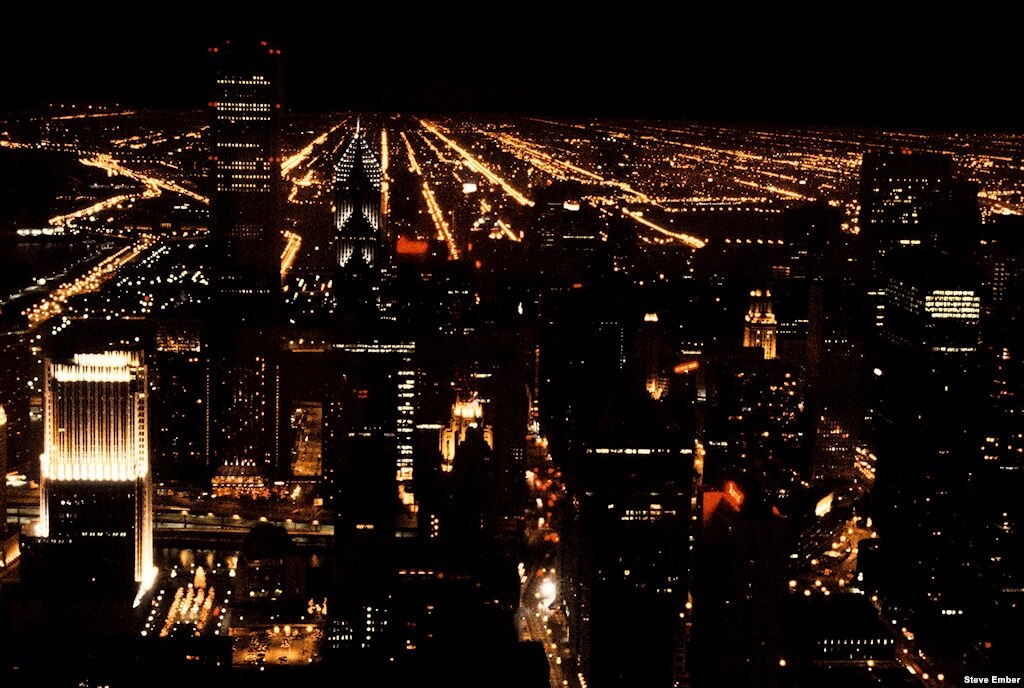
There are famous Chicago landmarks nearby, like the stately Drake Hotel. Towering above the beach is another one of Chicago’s modern tall buildings, the John Hancock Center, which also has an observation floor. While not as tall as the Willis Tower, “Big John,” as Chicagoans like to call the Hancock building, offers dramatic views of the shoreline of Lake Michigan, as well as the downtown panorama of Chicago’s many tall buildings that make up its distinctive skyline. The view is especially breathtaking at night!
A clear night's view toward downtown Chicago from the top of the John Hancock Center. The tall buiding on the left is the Aon Center; to its right, Two Prudential Plaza.


Lake Michigan is far more than a place to spend one’s free time…or look out over from Big John’s observation deck.  Chicago is a major industrial and commercial port.  It became a major port when the Saint Lawrence Seaway opened in 1959.  The seaway links the Great Lakes to the Atlantic Ocean, connecting many ports in both the U.S. and Canada.    

In addition to its natural beauty, Lake Michigan can bring not only heavy snows and sub-freezing temperatures in winter, but a brutal wind as well.

When the Wind Blows and the Snow Flies… 
A rooftop view from Marina City toward Lake Michigan. The taller building is the Aon Center; to its right, Two Prudential Plaza. (Photo by Steve Ember)A rooftop view from Marina City toward Lake Michigan. The taller building is the Aon Center; to its right, Two Prudential Plaza. (Photo by Steve Ember)

Over the years, Chicago has built the Pedway, an extensive network of underground pedestrian tunnels in the Loop that provide a more comfortable way to move about when the weather is unfriendly. A portion of the Pedway also connects the Loop with the Lakefront commuter rail stations to the east. The Pedway connects many of the downtown stores, office buildings, hotels, and apartment buildings, and even provides shops and services. So, in many cases, Chicagoans can reach their destinations without too much discomfort from the city’s difficult winters.                    

But back to Michigan Avenue, which is perhaps the best known street in Chicago.  Of course, musically some might argue with that statement…
On State Street, that great street
I just want to say,
They do things they don’t do on Broadway

More from that song later, but, as we were saying, Michigan Avenue…


It Survived the Great Fire of 1871
  
The Chicago Water Tower on the city's Magnificent Mile was one of the only buildings to survive the Great Chicago Fire of 1871. (Photo by Steve Ember)The Chicago Water Tower on the city's Magnificent Mile was one of the only buildings to survive the Great Chicago Fire of 1871. (Photo by Steve Ember)
The Chicago Water Tower on North Michigan Avenue is in the center of what Chicagoans call the Magnificent Mile.  Popular stores and large office buildings line the street.  The old water tower and nearby pumping station were among the few structures to survive the Great Chicago Fire of 1871.

Heading downtown on Michigan Avenue, we’ll stop and look up at the Tribune Tower and the Wrigley Building, watch the boats on the Chicago River, cross over the river on the Michigan Avenue Bridge, and spend some time relaxing in Millennium Park. The huge park covers 10 hectares, between Michigan and Columbus Drive to the east, and between East Randolph Street on the north and East Monroe on the south.  The park took almost nine years to finish and cost hundreds of millions of dollars.

Millennium Park has one of the largest outdoor sculptures in the world.  British artist Anish Kapoor created this 10-ton work of public art.  And the Catalan Spanish artist Jaume Plensa designed the Crown Fountain in the park.  It may be one of the world’s most unusual fountains.  The artist set a pool of water between two tall glass towers.  Video images appear on the towers.  The images are a series of pictures of objects in nature and people’s faces.  The water appears to fall from their mouths.  The faces represent the many different groups of people who live in Chicago.

About 45 percent of the population is white.  The city also has many African Americans and people of Hispanic ancestry, and a small percentage of Asians.  Over the years many immigrants have settled in Chicago.  Many people have ethnic roots in Poland, Russia, and other Slavic countries, Germany, Ireland or Italy.  But more recent immigrants have come from all over the world.
  
Chicago USA - August 24, 2010: Children playing in the Crown Fountain at Millenium ParkChicago USA - August 24, 2010: Children playing in the Crown Fountain at Millenium Park
Millennium Park was a dream of former Chicago mayor Richard M. Daley.  He was elected to the office six times and served just before current mayor Rahm Emanuel took office.  Mr. Daley and other city leaders believed a big park would bring more people, more homes and more businesses to the area.  Mr. Daley’s father, Richard J. Daley, also served as Chicago’s mayor for many years.
                                                   
Chicago is often called "the city that works."  And the Daleys were known for getting things done.  At its best, the city’s political machine has made things work smoothly, without major problems.  But at its worst, the buildup of power in one group led to cases of corruption over the years.

Chicago Offers Culture, Music, Art

The Chicago Cultural Center, stands on East Randolph Street at Michigan Avenue.  The building that now houses the center was completed in 1897.

Many people probably could spend all day there, and not get tired of it.  People say the restored building looks like a home for kings and queens.  Some call it “the People’s Palace.”  There are white walls made of marble from Carrara, Italy.  And there are two domes.  The bigger dome is one of the largest Tiffany designs in the world.  It rises almost 12 meters above the floor. Artists and musicians present free talks and perform at the cultural center.

Chicago is famous for its music, from rock, blues and jazz, to classical.  The Chicago Symphony is considered one of the world’s finest. Lurlean Hunter bridge

And if you like jazz and blues, be sure to visit Rush Street.
Lurlean Hunter sings:
If you could see me now, you’d know how blue I’ve been

Many great musicians of the past played in clubs there, and the tradition continues today.
Perhaps then you’d realize, I’m still in love with you

There is even a famous musical named “Chicago.”  The actor, dancer and film director Bob Fosse was born in Chicago.  He created dance routines for the musical, written by John Kander and Fred Ebb. The show opened on New York’s Broadway in 1975.

It had to do with Chicago’s colorful lawless era of the 1920s.

It starred Broadway greats Gwen Verdon, Jerry Ohrbach…and Chita Rivera.
Come on Babe, why don’t we paint the town
And all that jazz
I’m gonna rouge my knees and pull my stockings down
And all that jazz
Start the car, I know a whoopee spot
Where the gin is cold but the piano’s hot
It’s just a noisy hall where there’s a nightly brawl
And all that jazz

Well, now, as you can probably imagine, a city with so much to offer as Chicago, cannot really be sampled in just one program. So we will definitely come back another time…and show you more!

The L as Movie Star

We started our visit today by riding the L into Chicago’s Loop. The L is so much a part of Chicago that it’s not surprising to see it in many movies set in the “Windy City.”

Chicago "L" elevated train crosses Chicago River on the Wells Street Bridge, approaching Merchandise Mart station.

Film director Andrew Davis grew up in Chicago. He used the L in films including “The Package,” “Code of Silence,” “Above the Law,” and, of course, “The Fugitive.”

[Andrew Davis talks about filming “The Fugitive”]

“This is done on a moving train at night, back and forth, in a loop around The Loop. I’ve had a lot of experience shooting on the L’s in Chicago. Almost all of my films I’ve done there have the L as part of the fabric, and they were very cooperative with us.”

[From “The Fugitive” (Movie, 1993)]
L Motorman: Next stop, Balbo Station, Balbo
Andreas Katsoulas (the one-armed man): “This is my stop.”
Harrison Ford (Richard Kimble): “This is my stop, too.”
Transit Policeman: “Kimble!” [Gunshots]
[L Train goes into emergency stop as Kimble pulls emergency handle]
Harrison Ford (Kimble): “You missed your stop!”

Andrew Davis: “I love you, Chicago!”

So do we!  This program was written by Jerilyn Watson, who grew up in Chicago, and by yours truly Steve Ember, who likes to visit, ride the L, look at the exciting mix of architecture, and take pictures in the “Windy City” whenever he can.  Join us again next week for another This is America from VOA Learning English.

Frank Sinatra sings “Chicago”
Chicago, Chicago, that toddlin’ town
Chicago, Chicago, I’ll show you around
I love it
Bet your bottom dollar, you’ll lose the blues in Chicago, Chicago
The town that [evangelist] Billy Sunday couldn’t shut down
On State Street, that great street, I just want to say,
They do things they don’t do on Broadway
They have the time, the time of their life
I saw a man, he danced with his wife
In Chicago, Chicago, my home town

VOCABULARY
sculpture: the art of making 2 or 3 dimensional representative
extensive: a - cover a large area
eye-catcher: attraction
columnist: n - journalist
southward: a- in a southerly direction
stretch out: make wider or longer
panorama: a unbroken view of a region
breathtaking:a- astonishing
millenium: a period of thousand year
corruption: dishonest,