Saturday, March 22, 2014

[VOA] Will Sanctions Against Russia Work? Voa Special English

Will Sanctions Against Russia Work?
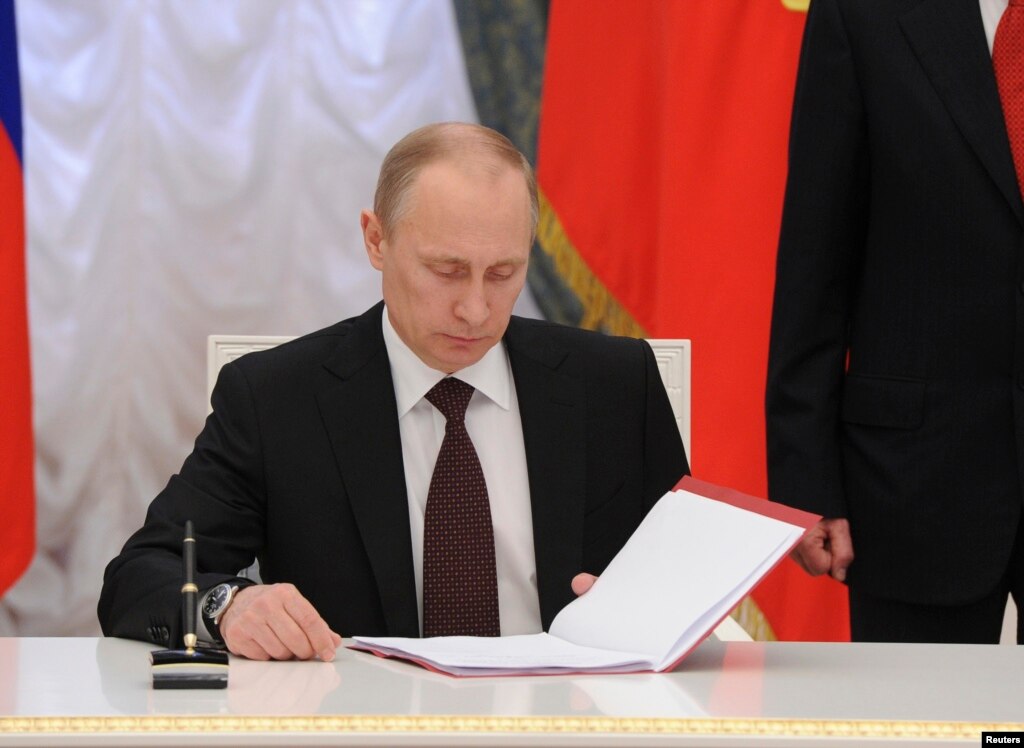
Russian President Vladimir Putin prepares to sign a law on ratification of a treaty making Crimea part of Russia, March 21, 2014.

Play or download an MP3 of this story
From VOA Learning English, this is In The News.
                                                                        
Russian President Vladimir Putin has signed a law forRussia to officially take control of the Crimeanpeninsula.  The signing ceremony took place on Fridayafter the upper house of Russia’s parliament voted tomake Crimea a part of Russia.  The lower houseapproved the deal on Thursday, just four days afterCrimean voters decided to leave Ukraine and joinRussia. 

Local officials in Crimea called a special election on the area’s future after Ukrainian lawmakers voted to oustPresident Viktor Yanukovych.  The reported electionresults were one-sided.  Ninety-seven percent of thosemarking ballots chose to join Russia.  Crimean officialsannounced that over 80 percent of everyone permitted to vote took part in thereferendum. 
                                                  
The Russian president said the vote met international and democratic valuesfor fairness.  But many observers questioned the results.  Robert Legvold iswith Columbia University in New York City.

"If it was an honest vote and all groups had participated, I would have thoughtrather than an overwhelming vote, it would have been something like 52 to 53percent, given the percentage makeup of the groups in Crimea.  The fact that it’s 97-point-whatever and they report a turnout of 83 percent, creates somesuspicion that it wasn’t just the shadow of the Russian military presence, butmaybe even some manipulation.” 

Matthew Rojansky works for the Woodrow Wilson International Center forScholars in Washington.  He thinks the pro-Russian officials in Crimea heldthe referendum because they expected the results.

“My sense is this was a product of the times in which there has been a realbuild-up of fear mongering and the overt pressure of armed men.  There isnothing quite like a gun in your face.”

West Rejects Crimean Vote

The United States and the European Union have described the referendum inCrimea as illegal and in violation of Ukraine’s constitution.  US and EU officialsreacted quickly.  They ordered travel bans and financial restrictions on 28Russian officials and four Ukrainians.  US officials have described thosetargeted as President Putin’s “cronies.”
                                                                        
Matthew Rojansky says that, for over a year, Mr. Putin urged top Russianofficials to sell their international holdings and bring their wealth back toRussia.

“Anybody who has complied with him is sitting pretty and doesn’t have toworry about the international sanctions, and anyone who didn’t - well, it’s theirproblem; he can cut them loose.” 

Sanctions Not Strong Enough

He also believes the current sanctions are not strong enough. 

“I don’t think Putin believes us.  I don’t think he thinks we actually have the gutsto impose really biting sanctions on, for example, the energy sector.  I think hejust distrusts our resolve because we haven’t made it clear that we are willingto pay the pain on our side.”  

Robert Legvold of Columbia University believes stronger sanctions could hurtthe world economy.

“Every step that escalates the penalty or the punishment also escalates thecost to those inflicting them, imposing the sanctions.”

On Thursday, President Obama announced additional sanctions on Russianindividuals and one bank.  Russia reacted to the announcement by orderingentry bans on nine US lawmakers and officials.  The following day, Ukraine’sacting prime minister signed a political association agreement with the EU.

Observers say it will be very difficult to change what has happened in Crimea.  Experts also say it will be interesting to see how far the United States and itsWestern allies are willing to go to punish Russia for its actions.

And that’s In The News from VOA Learning English.  I’m Steve Ember.

Thursday, March 20, 2014

[VOA] UN Chief Wants 3,000 Troops Sent to Central African Republic

UN Chief Wants 3,000 Troops Sent to Central African Republic

Angry young men complain to French soldiers in patrol in the pro-Christian area of Bangui February 15, 2014
TEXT SIZE 
United Nations Secretary-General Ban Ki-moon hasappealed for international action to stop religiousviolence in the Central African Republic.  Mr. Ban askedthe Security Council on Thursday to deploy at least3,000 more troops to the country within the comingdays and weeks.  He said, “When innocent civilians arebeing murdered in large numbers, deliberately targetedin the most brutal fashion, simply because of who theyare, the world must act.” 

More than 7,000 African Union and French forces arealready in the country.  The European Union haspromised to send another 1,000 soldiers.  The CentralAfrican Republic is a former French colony. 

This week, Mr. Ban also proposed $38 million in financial and other aid for theAU forces.  He worries the religious violence could turn into genocide.  Theunrest began a year ago after Muslim rebels ousted the president, FrancoisBozize.  His overthrow and resulting violence led to a majority Christianmilitia.  Its members are accused of carrying out attacks against Muslimcivilians.  Since December, hundreds of people have died in clashes betweenMuslims and Christians.  Tens of thousands have fled the country in the pastmonth. 
                                          
The militia men call themselves the anti-balaka.  Balaka is said to be a wordfor knife or machete in a local language.       Militia members say they came to the capital, Bangui, in December to oust the government of Michel Djotodia, the country’s first Muslim president.  But international forces have accused theanti-balaka of being the problem.  They say its fighters are increasingly turningto attacking homes and businesses.

Some fighters are only teenagers.  They have set up roadblocks on countryroads, carrying weapons and demanding money.  French and African troopshave used force to disarm them. 
                                                                 
The anti-balaka has been described as a loose alliance, and several leadersclaim to speak for the men.  Joachim Kokate represented the militia at ameeting in January.  He says it is time for justice.  He says those organizingtheft and extrajudicial killings should be targeted, and they should answer fortheir acts.
                    
Many anti-balaka fighters tell VOA they want the same treatment the MuslimSeleka rebels are receiving.  That means they want food, shelter and financialaid.  They also want the chance to join the national army as part of adisarmament agreement. 

Some fighters consider themselves liberators of their country.  Others see theconflict as becoming a battle between religious groups.  But the militias aremade up of both Christians and animists, people who believe that naturalobjects have spirits.  They say they are motivated by nationalism -- notreligion.                                     
                                          
Anti-balaka leaders say they have tens of thousands of fighters. 

Sunday, March 16, 2014

Crimean Lawmakers Vote to Leave Ukraine, Join Russia

Crimean Lawmakers Vote to Leave Ukraine, Join Russia

  • In the News - March 8, 2014


    From VOA Learning English, this is In The News.                                                                                                 
    The crisis in Ukraine continued this week.  OnThursday, lawmakers in Crimea approved a measureto make the peninsula part of Russia.  The Crimeanlawmakers also called a referendum on the issue.  Thespecial election is set for March 16th.
                                              
    Sergei Shuvainikov is a deputy in the Crimeanparliament.  He said voters would be asked twoquestions: “First, ‘Do you vote for the reunion of Crimeawith the Russian Federation, as a subject of theRussian Federation?’  Second, ‘Do you vote for therestoration of the 1992 constitution and for Crimea to bepart of Ukraine?’”
                               
    The vote in the Crimean parliament came as European Union leaders heldemergency meetings in Brussels, Belgium.  EU officials want to pressureRussia into recalling military forces from Crimea. 
                                       
    An aide to the commander of Ukraine’s border guards said there are now30,000 Russian soldiers in the area.  That is in comparison to the 11,000troops that were with Russia’s Black Sea fleet in the port of Sevastopol beforethe crisis began.  Russian officials have denied the additional soldiers belongto its armed forces. 

    Yatsenyuk dismisses vote to join Russia
                        
    Ukraine’s acting Prime Minister, Arseniy Yatsenyuk, was at the talks inBrussels.  He dismissed the Crimean parliament’s vote to join Russia.

    “This is illegitimate decision and this so-called referendum has no legalgrounds at all. That’s the reason why we urge the Russian government not tosupport those who claim separatism in Ukraine. Crimea was, is and will be anintegral part of Ukraine.”

    He also said his government is open to talks with Russia about the crisis.

    “We are ready for co-operation, but we are not ready to surrender and to be the subordinate of Russia.”

    The situation in Ukraine has worsened Russian relations with the West,including the United States.  President Barack Obama says the presence ofRussian forces in the Crimean peninsula violates Ukraine’s rights as anindependent country.  On Thursday, he ordered sanctions against individualsfound to have violated Ukraine’s territorial integrity.  The actions include visarestrictions.  The EU also announced measures against Russia, suspendingtalks on visas and a new economic agreement. 

    Obama and Putin discuss situation by telephone

    President Obama and Russian President Vladimir Putin spoke by telephonefor about an hour on Thursday.  President Putin dismissed an Americanwarning over Russia’s involvement in Crimea.  Russian officials said Mr. Putindenounced Ukraine’s new western-supported government as “illegitimate”.  And he said his country cannot ignore calls for help from Crimea and theeastern and southern parts of Ukraine. 

    As a way of finding a solution to the crisis, President Obama called for directtalks between Russia and Ukraine. 

    Mr. Obama is not alone in his reaction to the increased Russian involvementin Crimea.  A top official of the European Union called the Russian actionsillegal.  Jan Tombinski, the EU’s representative in Russia, said Crimea cannotdecide to leave Ukraine just because of an election that included only Crimea.  He said article 73 in Ukraine’s constitution makes the referendum illegal. 

    And that’s In the News from VOA Learning English.  I’m Steve Ember
    Source: VOA